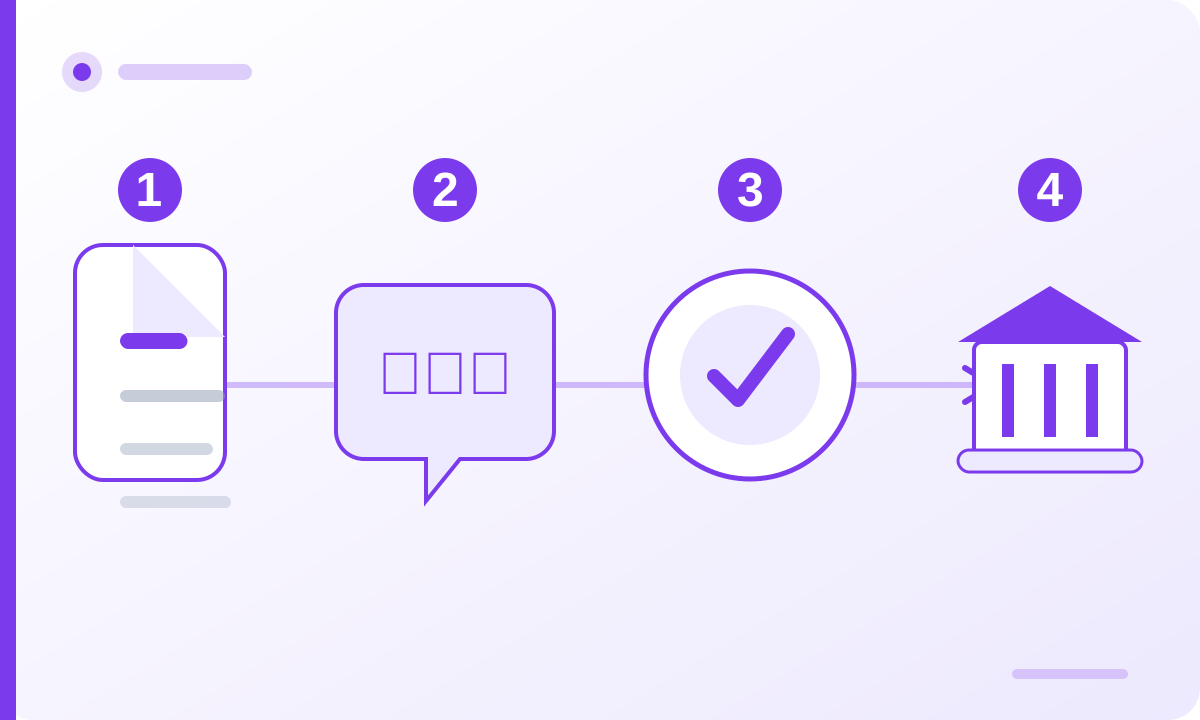

Japanese translation: key facts for 2026
- • Japan does not have a single national sworn-translator credential. Accepted format depends on the destination: translator-signed declaration of accuracy on letterhead, optionally notarised at a Japanese kōshōnin.
- • Apostille on a Japanese translation requires notarisation first; a translation is a private document under the Hague framework. The notarisation makes the translator certification a notarised public-document act that can carry apostille.
- • Specified Skilled Worker (SSW / Tokutei Ginō) visa for nursing care, hospitality, construction, agriculture, food manufacturing, and other specified sectors. Requires JLPT N4 or higher (sometimes N3) plus Specified Skills exam pass.
- • Translation runs from a scan; the Original Indian document does not travel for translation. The Original travels separately for the MEA apostille step.
- • Japanese university Certificate of Eligibility (COE) sponsored by the destination Japanese university; the university applies to the Ministry of Justice Immigration Services Agency on behalf of the Indian student.
- • Permanent Residence (Eijūken) after 10 years residence, or shorter Highly Skilled Professional (HSP) 70-point or 80-point route (3 or 1 year). Indian academic and work-experience documents feed into the HSP points calculation.
- • Japanese koseki municipal offices register marriage and birth of Indian-Japanese family events. Tokyo, Osaka, Yokohama, Nagoya, Sapporo, Fukuoka, Kobe, Kyoto, Sendai each have their own desk practice.
Japan has no national sworn-translator licence: what that means for your documents
Most European countries have one national list of sworn translators: Germany's court-appointed sworn translator (vereidigter Übersetzer) per Land court, France's traducteur assermenté per Cour d'Appel, Poland's tłumacz przysięgły on the Ministry of Justice register, Spain's traductor jurado authorised by MAEC, the Czech court-appointed sworn translator (soudní tlumočník), Slovakia's úradný prekladateľ, and Slovenia's sodno zapriseženi prevajalec. Japan is different. Japan has no national body that licenses translators, so a document translated by a translator who is not certified by such an association is still accepted as a translation of an official document.
What that means at intake: we coordinate Japanese translation through translators whose work the destination Japanese authority has accepted before, rather than through a single national-register lookup. For Japanese municipal koseki offices the translator who has worked with the destination municipality's desk before is the safer choice. For SSW healthcare-sector visas the translator with sector experience and the destination employer's confidence is the safer choice. For Permanent Residence applications at the Immigration Services Agency the translator with PR-office acceptance history is the safer choice.
Apostille on a Japanese translation: the notarisation prerequisite
The Hague Apostille Convention covers public documents. A translation is a private document. The Ministry of Foreign Affairs of Japan (MOFA Japan) and the Ministry of External Affairs of India both apostille public documents. To get apostille on a translation, the translation must first be notarised at a notary public; the notarisation makes the translator's certification a notarised public-document act, and the apostille can then go on the notarised certification.
For India-side direction (Indian document going to Japan, Japanese translation done in India), the notarisation is at an Indian Notary and the apostille is by MEA. For Japan-side direction (Japanese document coming to India, Japanese-to-English translation done in Japan), the notarisation is at a Japanese kōshōnin and the apostille is by MOFA Japan. We confirm the direction and the destination-authority requirement at intake before commissioning translation.
When you actually need to send us the Original
Japanese translation work runs from a scan. The Japanese translator works from a clear photograph or scan of the Indian document and delivers the translated version with the translator's signed certification on letterhead. The Original Indian document does not travel for translation.
For the MEA apostille on the Indian side, the Original does travel to our Noida office. MEA stamps the actual paper. Where apostille on the translation itself is additionally required by the destination Japanese authority, the translator's certification is notarised first and then apostilled.
Which Japanese authority will actually read this translation
Japanese municipal koseki office. Marriage registration and birth registration of Indian-Japanese family events at the planned-residence city's koseki desk. Tokyo (Shinjuku, Shibuya, Minato, Chiyoda, etc.), Osaka, Yokohama, Nagoya, Sapporo, Fukuoka, Kobe, Kyoto, Sendai. Each koseki desk has its own format practice; we coordinate with translators who have worked with the destination municipality before.
Ministry of Justice Immigration Services Agency (Shutsunyūkoku-zairyū kanri-chō) for COE and Permanent Residence. The Immigration Services Agency processes the Certificate of Eligibility (COE) for visa sponsorship and the Permanent Residence (Eijūken) application. Indian documents apostilled and Japanese-translated.
Embassy of Japan New Delhi and Japanese Consulates in Mumbai, Chennai, Kolkata, Bengaluru. Visa-stamping after COE issuance. The Embassy and Consulates often accept English-language Indian documents for the visa-stamping step itself, with Japanese translation needed for the downstream filing in Japan.
Specified Skilled Worker (SSW / Tokutei Ginō) employer or sector-specific authority. Nursing care under the Ministry of Health, Labour and Welfare. Hospitality and food and beverage manufacturing under sector-specific recognition. Construction and agriculture under their sector bodies. The Specified Skills exam pass certificate (sector-specific in Japan or in India) plus JLPT N4 or higher feed into the COE application.
Highly Skilled Professional (HSP) 70-point or 80-point route. Indian IT professionals, researchers, business professionals applying through the HSP route. Indian academic credentials, work-experience certificates, and salary documentation feed into the points calculation; PR application possible after 3 or 1 year of HSP residence (70 or 80 points).
Japanese university admission office and koseki of the university's prefecture. The destination Japanese university (University of Tokyo, Kyoto University, Osaka University, Hokkaido University, Tohoku University, Nagoya University, Kyushu University, the private universities Waseda, Keio, Sophia, ICU) admits the Indian student and applies for the COE.
Japanese healthcare regulators for Indian medical, nursing, pharmacy registration. Indian medical and nursing professionals in Japan typically work through the Indian-trained nurse / care worker route via the SSW nursing care category or through bilateral agreements (Japan-India EPA nursing-and-care-worker programme). Each route has its own documentary expectation.
What we will not pretend
We are not a Japanese sworn-translator association. Japan has no single such body. We coordinate Japanese translation through translators whose work the destination Japanese authority has accepted before; the choice of translator depends on the destination, not on a national-register lookup.
We do not run SSW or Permanent Residence applications on behalf of the candidate. The Immigration Services Agency processes these. We deliver the apostilled-and-Japanese-translated Indian documents in the format the destination Japanese authority asks for.
We do not arrange JLPT examinations, Specified Skills examinations, or Japanese-language proficiency tests. The candidate sits those tests; we deliver the apostilled certificates and translation work.
Custody discipline on a Japanese case
Your original documents are not something we ever take lightly on a Japan case. The MBBS or BSc Nursing degree for the SSW healthcare candidate; the Class 12 board certificate and degree for the university applicant; the marriage certificate from the Indian sub-registrar for the koseki registration; we log each at intake with a Customer ID and a Document ID. The printed checklist is signed at every handoff: Notary, State HRD or SDM, MEA submission, MEA collection, courier outbound to the Japanese translator, courier return.
We use Blue Dart, DHL, FedEx, DTDC Premium, UPS for inter-city and international legs. We do not use Porter, Wefast, Borzo or similar third-party parcel apps. WhatsApp photo and video proof of every stamp on the journey.
Frequently asked questions
Japan does not have a single national sworn-translator credential. So what is the accepted translation format?
Correct, Japan has no single national sworn-translator licensing body the way Germany, France, Poland, or Spain do. The Japanese accepted format depends on the receiving authority. Japanese municipal koseki offices and the Permanent Residence office at the Ministry of Justice typically accept translator-signed declarations of accuracy on letterhead, sometimes notarised by a Japanese kōshōnin (notary public). The Japanese Embassy of Japan New Delhi and Japanese Consulates often accept English-language Indian documents for visa-stamping itself, but the downstream filing inside Japan reads Japanese. We coordinate with Japanese translators who have worked with the destination authority before.
Apostille on a Japanese translation. Why does the notarisation step matter?
A translation is a private document under the Hague Apostille framework, not a public document. The Ministry of Foreign Affairs of Japan (MOFA Japan) and the Ministry of External Affairs of India both apostille public documents. To get apostille on a translation, the translation must first be notarised at a notary public (a kōshōnin in Japan, a Notary in India for India-side reverse direction). Notarising the translation turns the translator's certificate into a public document, and the apostille can then be placed on that notarised certificate. We name this step at intake on every case where apostille on the translation is required by the destination.
Specified Skilled Worker (SSW) visa for Indian healthcare, hospitality, agriculture, or construction worker. What is the documentary path?
SSW (Tokutei Ginō) covers nursing care, hospitality, construction, agriculture, food and beverage manufacturing, building cleaning, and other specified sectors. For Indian SSW applicants the documentary set typically includes: degree or vocational qualification, Specified Skills exam pass certificate, JLPT N4 or higher (some sectors N3), Indian PCC, work-experience certificates. India-side MEA apostille on the Indian originals; Japanese translation by translator with Japanese-Embassy or sector-specific recognition; submission at the Embassy of Japan New Delhi for the COE (Certificate of Eligibility) followed by visa stamping. SSW processing typically 1 to 3 months at the Japanese end.
Japanese university admission via COE (Certificate of Eligibility). How does the Indian academic document work?
Japanese universities sponsor the COE for the international student. For Indian undergraduate, postgraduate, and research-student applicants: degree certificate (State HRD or SDM as document type asks, MEA apostille), transcripts, Japanese-language proficiency (JLPT N3 or higher for some programmes, N1 or N2 for graduate research), financial means, recommendation letters where required. The destination Japanese university's admission office reviews; the Japanese university then applies for the COE on the applicant's behalf with the Ministry of Justice Immigration Services Agency.
Koseki office for marriage registration of an Indian-Japanese couple. What does it want?
The Japanese municipal koseki office at the planned-residence city registers the marriage of an Indian-Japanese couple. For an Indian spouse: birth certificate (MEA apostilled + Japanese translation), Indian single status affidavit if not registering retroactively in India (SDM-executed + MEA apostille + Japanese translation), Indian passport copy. The Japanese spouse provides the Japanese-side documentation. Tokyo, Osaka, Yokohama, Nagoya, Sapporo, Fukuoka, Kobe, Kyoto, Sendai municipal offices each have their own koseki desk practice; we coordinate with translators who have worked with the destination municipality before.
Permanent Residence (Eijūken) application for an Indian applicant after 10 years (or shorter Highly Skilled Professional route). What translation is needed?
Permanent Residence applications at the Immigration Services Agency of Japan read the full personal-history documentary set: tax certificates (Japanese-side), employment proof (Japanese-side), Indian birth certificate, Indian academic credentials, Indian PCC, all translated to Japanese. The Highly Skilled Professional (HSP) 70-point or 80-point route allows shorter residence period (3 or 1 year) for PR application; the academic and work-experience documents from India feed into the points calculation. Apostille on the Indian originals; Japanese translation by translator with Permanent Residence office acceptance history.
Do I need to send the Original Indian document for Japanese translation?
For translation alone, a clear scan or photograph is enough. The Japanese translator works from the image and produces the translation with translator's certification on letterhead. The Original Indian document travels separately for the MEA apostille step in India. Where apostille on the translation itself is required by the destination Japanese authority, the translator's certification is notarised first, then apostilled.
How long does the Japanese translation step take?
For a standard family or student document pack: 5 to 10 working days at the Japanese translator. For SSW and Permanent Residence multi-document bundles, the timeline extends to 10 to 20 working days. Where notarisation and apostille on the translation are additionally required, add 3 to 5 working days for those steps. We get an estimate from the translator before accepting the file.
SiZA Global verification, for the customer who wants to check before sending Originals
- • Operated by SiZA Global Solutions Private Limited, registered office: C-25, Sector 8, Noida, Uttar Pradesh 201301, India.
- • UDYAM registration: UDYAM-UP-28-0217175 (Ministry of MSME, Government of India).
- • Verifiable completed-work portfolio at /about and the SiZA Global anti-scam verification protocol at /anti-scam-notice.
- • Content is reviewed by the SiZA Global Documentation Desk. Country-specific instructions are checked against the receiving authority before a file starts.
Related desks
Reviewed by the SiZA Global Documentation Desk on 29 May 2026 (SiZA Global Solutions Private Limited, registered office: C-25, Sector 8, Noida, Uttar Pradesh 201301, India; verified completed-work portfolio at /about and /anti-scam-notice). Japanese Ministry of Justice Immigration Services Agency procedures, SSW sector recognition, koseki municipal-desk practice, COE processing, and apostille / notarisation requirements are not static. Every Japanese case begins with a check of the destination Japanese authority's current rule for the specific use case.